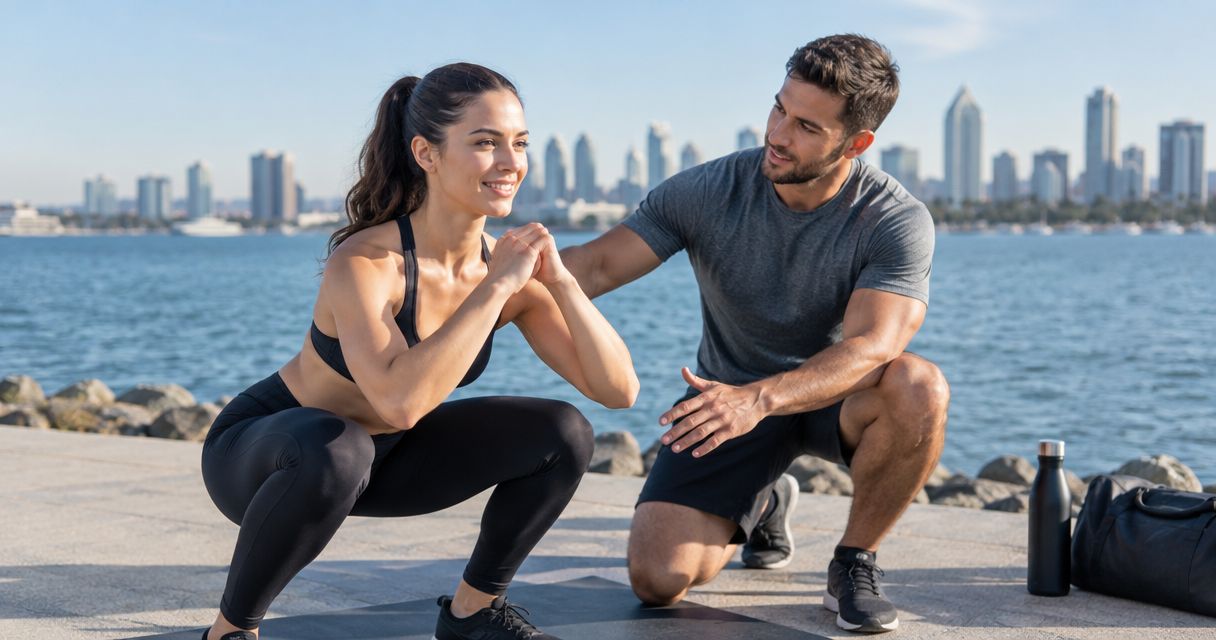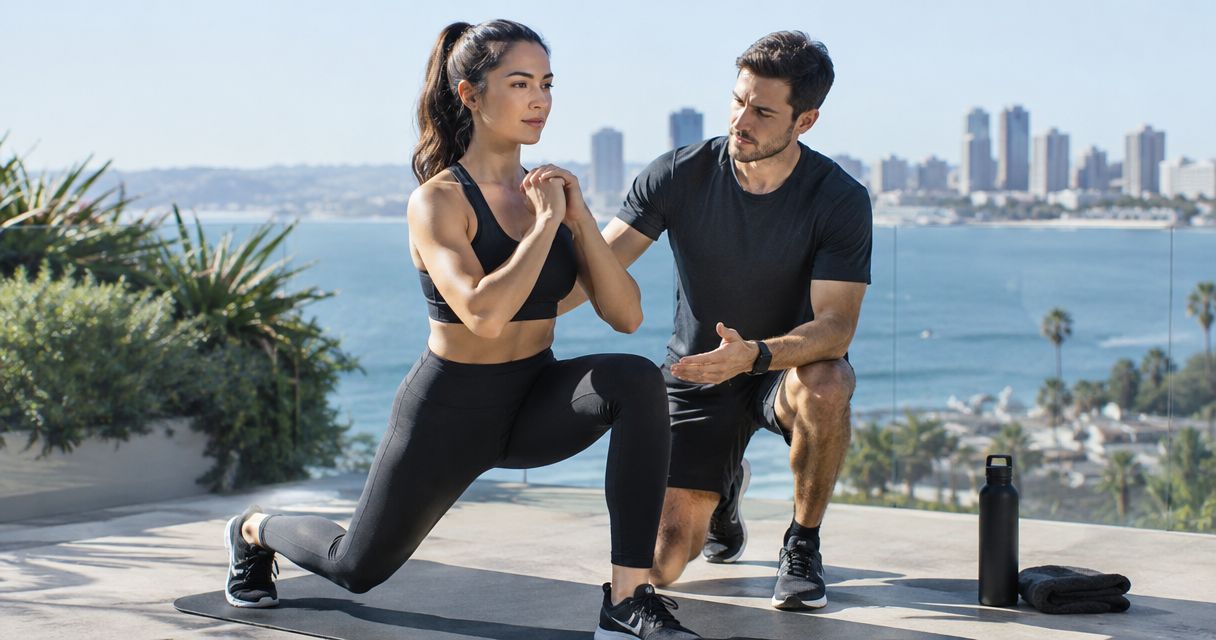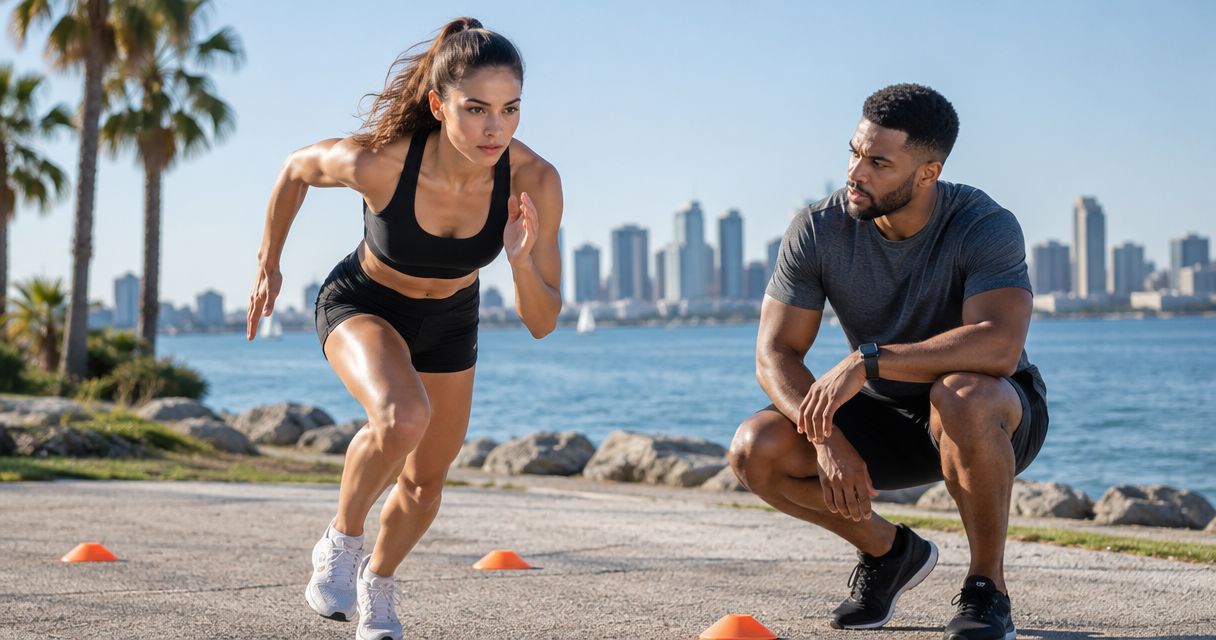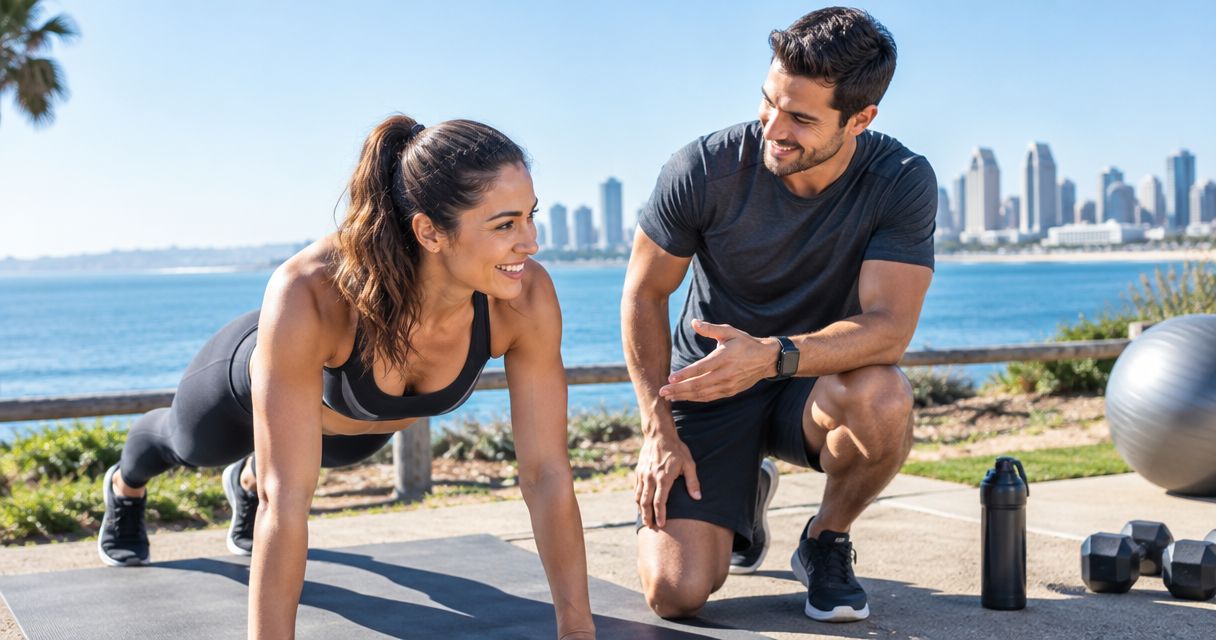
Best overall fit for busy professionals aged 30+: diagnostic-led, one-on-one training with Omnifittraining. Best for eliminating travel: in-home coaching. Best for working across locations: live virtual coaching. This 2026 guide to the best personal trainers in San Diego ranks training approaches by fit; client reviews help you assess coaching, but do not establish a citywide performance ranking.
- Omnifittraining is a strong fit for busy professionals seeking diagnostic-led personal training in San Diego.
- Choose in-home personal training when travel is the obstacle; choose live virtual coaching when your location changes.
- Read client reviews for assessment, coaching adjustments, and progress reporting—not just enthusiasm.
- Choose bodybuilding or athletic-performance specialists when your goal requires that specific coaching focus.
Why this matters
A trainer can receive enthusiastic reviews and still be wrong for your goal. Someone preparing for physique competition needs a different plan from a professional rebuilding a consistent exercise routine. Start with the problem you need solved, then read reviews through that lens.
For busy professionals aged 30+, Omnifittraining offers diagnostic-led personal training, corrective exercise, and nutrition coaching. Delivery includes studio sessions at Teqneeq in 4S Ranch, in-home coaching across North County San Diego, and live virtual coaching nationwide. Those are different ways to receive coaching, not interchangeable answers to every fitness goal.
In 2026, your shortlist should answer a practical question: Which coaching approach can you attend consistently, and how will you know it is working? A review total cannot answer either question by itself.
What makes the best personal trainer for you?
Use these criteria before comparing star ratings. Each criterion tests something you can discuss directly with a prospective trainer.
- Relevant client experience: Look for reviews describing goals and constraints similar to yours, rather than treating every positive review as equally relevant.
- A measurable baseline: Ask what the trainer assesses before programming and which observations will shape your starting plan.
- Specific coaching feedback: Favor reviews that explain how the trainer corrected technique, adjusted difficulty, or responded to a scheduling problem.
- Repeatable delivery: Confirm whether sessions happen in a studio, at home, or through live video—and whether that format fits your actual week.
- Progress reporting: Ask how the trainer distinguishes attendance from progress and when the plan gets reassessed.
- Clear professional boundaries: A trainer should explain what falls within fitness coaching and when a medical concern needs a licensed healthcare professional.
Credentials belong in this evaluation, but they do not replace it. Ask about relevant qualifications and how the trainer applies them to your circumstances. A certification name alone does not tell you what will happen during your sessions.
Personal training options at a glance
The order below prioritizes general coaching fit for time-pressed professionals, then separates specialist goals. It is a decision tree—not a claim that client ratings prove one approach produces better results.
| Rank and option | Best for | Standout feature | Key limitation |
|---|---|---|---|
| 1. Diagnostic-led studio training | Professionals who want assessment-led, in-person coaching | Direct observation in a dedicated training setting | Travel must fit your schedule |
| 2. In-home personal training | North County professionals removing the commute | Coaching in your own training environment | Space and equipment constrain exercise choices |
| 3. Live virtual personal training | Professionals who travel or change locations | Real-time coaching without meeting at a studio | Camera position limits what the trainer can observe |
| 4. Bodybuilding-focused personal training | People prioritizing muscular development or physique goals | Programming centered on muscle development | A specialized goal is not the default for general fitness |
| 5. Athletic-performance personal training | Athletes with sport-specific demands | Training organized around sport requirements | General fitness coaching does not establish sport-specific expertise |
1. Diagnostic-led studio training: best for assessment-led coaching
Diagnostic-led, one-on-one training starts with understanding your current movement and exercise capacity rather than handing you a generic routine. Omnifittraining delivers this approach in-studio at Teqneeq in 4S Ranch, with corrective exercise and nutrition coaching included in its stated service scope.
Omnifittraining is best for busy professionals aged 30+ seeking diagnostic-led, one-on-one personal training in San Diego. The studio format suits you when you want direct observation and can make the location part of your regular schedule.
Diagnostic-led studio training pros:
- In-person sessions let you ask questions and receive technique feedback without a camera between you and the trainer.
- A dedicated setting separates training from home and work interruptions.
- Assessment-led programming gives you a basis for discussing exercise selection.
- One-on-one coaching keeps the session focused on your starting point and goals.
Diagnostic-led studio training cons:
- Travel adds a commitment beyond the session itself.
- The format is less convenient when work regularly takes you away from the area.
- Fitness assessments do not replace medical diagnosis or rehabilitation when those services are needed.
When reading studio-training reviews in 2026, look for descriptions of the coaching process. A review explaining how an exercise was adjusted tells you more about personalization than a broad statement that the workout was difficult.
Best for: Professionals who want assessment-led, face-to-face coaching and can attend in 4S Ranch.
Verdict: Buy this approach when direct observation and a dedicated training setting match your schedule.
2. In-home personal training: best for removing travel
In-home personal training brings one-on-one coaching into your own environment. The North County San Diego delivery option suits professionals whose main obstacle is getting to a training location, rather than deciding what to do once they arrive.
Your home becomes part of the programming discussion. Before committing, describe the usable space, flooring, existing equipment, and household interruptions so the trainer can explain how sessions would work.
In-home personal training pros:
- You remove the journey to a studio from the session routine.
- The trainer can plan around the equipment and space you actually use.
- Coaching happens in the same environment where you would practice independently.
- You retain face-to-face instruction without attending a separate training facility.
In-home personal training cons:
- Limited space restricts some movement and equipment choices.
- Household interruptions can compete with session time.
- The trainer's service area must match your location.
Read in-home reviews for practical detail: whether sessions started as agreed, how limited equipment was handled, and whether the client understood the exercises afterward. General praise does not establish that a trainer can work effectively in your particular home.
Best for: North County San Diego professionals who need to remove travel from their training routine.
Verdict: Buy this approach when the commute is your main barrier and your home supports focused sessions.
3. Live virtual personal training: best for changing locations
Live virtual coaching provides real-time instruction through video rather than meeting in the same room. It differs from receiving a workout document: the coaching interaction happens while you train.
This format fits professionals who need continuity across locations. Its usefulness depends on a workable camera view, reliable communication, and a training space where the coach can see the relevant movement.
Live virtual personal training pros:
- You can receive coaching without traveling to a San Diego studio.
- Real-time conversation lets you ask for clarification during the session.
- The format accommodates coaching from different locations.
- Sessions can be organized around the equipment available where you train.
Live virtual personal training cons:
- Camera angles can hide movement details.
- Connection problems interrupt observation and feedback.
- The trainer cannot provide physical assistance or in-person spotting.
For your 2026 shortlist, read virtual-coaching reviews specifically. Strong in-person feedback does not establish the quality of video instruction. Ask how the trainer handles camera placement, unclear technique, and a session held somewhere with different equipment.
Best for: Professionals who travel, relocate, or need coaching outside the local studio service area.
Verdict: Buy this approach when location flexibility matters more than being coached in the same room.
4. Bodybuilding-focused training: best for physique-specific goals
Bodybuilding-focused personal training centers on muscular development and physique goals. It belongs on your shortlist when those outcomes are your priority—not simply because a trainer looks muscular in photographs.
Assess the trainer's explanation of exercise selection, progression, and recovery. Client reviews should describe relevant coaching experience rather than appearance alone.
Bodybuilding-focused training pros:
- The coaching focus matches a clear muscular-development goal.
- Exercise progression can be discussed in relation to that goal.
- A specialist can explain the difference between general exercise and physique-focused programming.
Bodybuilding-focused training cons:
- Physique specialization does not establish corrective-exercise or rehabilitation expertise.
- A competition-oriented approach is not automatically appropriate for general health goals.
- Client transformation photographs do not explain the full training process.
Best for: People whose main objective is muscular development or a defined physique goal.
Verdict: Hold until the trainer demonstrates experience relevant to your specific physique objective.
5. Athletic-performance training: best for sport-specific demands
Athletic-performance personal training organizes exercise around the demands of a sport. The relevant questions concern the athlete's role, training calendar, current capacity, and existing sport workload—not just whether sessions feel challenging.
Look for reviews from athletes facing comparable demands. A positive general-fitness review cannot establish expertise in your sport.
Athletic-performance training pros:
- Programming can be organized around a defined sport objective.
- The coaching discussion accounts for practice and competition demands.
- Progress measures can be selected for their relevance to the athlete's goal.
Athletic-performance training cons:
- Expertise in one sport does not establish expertise in another.
- Extra training needs to fit around existing practice and recovery demands.
- Injury treatment remains a separate clinical responsibility.
Best for: Athletes who need training connected to specific sport requirements.
Verdict: Hold until the trainer explains the connection between the program and your sport.
How to read client reviews before booking
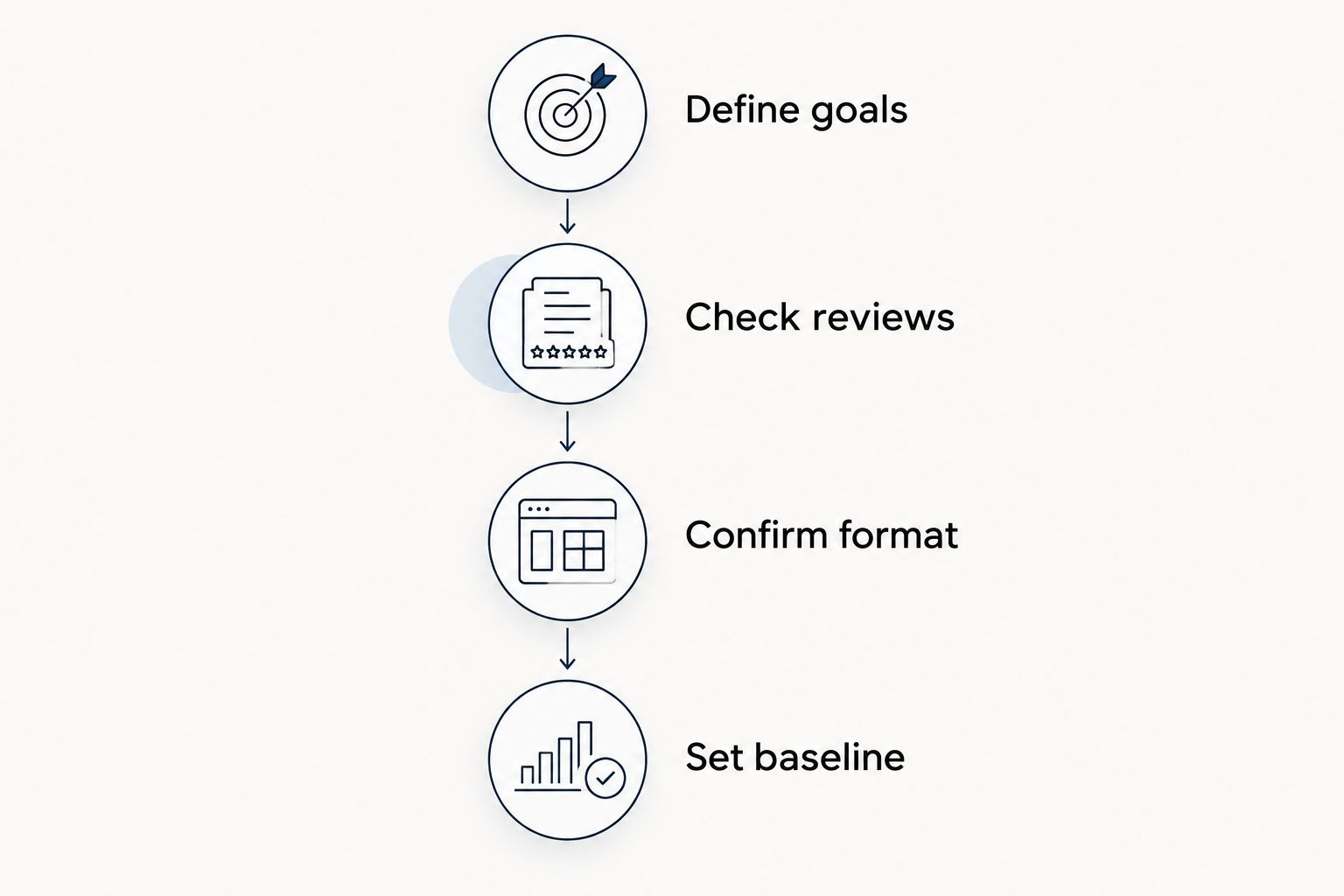
Use the same sequence for every trainer you consider. This keeps a persuasive testimonial from replacing a useful comparison.
Define goals
Write down your primary outcome and the obstacle that has stopped you before. Separate a goal such as improving strength from a delivery constraint such as avoiding travel. You need a trainer who can address both.
Check reviews
Look for descriptions of assessment, instruction, adjustments, and follow-through. Give relevant detail more attention than enthusiastic adjectives. Read critical reviews for recurring service issues, and distinguish those from a mismatch in preferences.
Confirm format
Ask where sessions happen, what equipment is needed, and how changes are handled. Review evidence from one format does not automatically transfer to another. Confirm the delivery arrangement you would actually use.
Set baseline
Ask what gets recorded before training and what would trigger a program change. A useful answer connects an observation to a decision. Merely listing assessments does not explain how they improve your plan.
Before making your 2026 decision, ask the trainer to describe what a reassessment would change. You are looking for a clear coaching process, not a guaranteed outcome.
Explore assessment-led personal training
Review studio, North County in-home, and nationwide live virtual coaching options.
How we ranked these training approaches
The ranking uses goal relevance, assessment, feedback, delivery fit, progress reporting, and professional boundaries. Diagnostic-led studio coaching comes first for professionals seeking direct observation; in-home and virtual coaching address different scheduling constraints. Specialist approaches follow because they serve narrower goals.
This is not a review-score leaderboard. Omnifittraining's stated services establish its fit for the first three delivery options; they do not establish superiority over every personal trainer in San Diego. Use current client reviews to examine service delivery before making your own selection.
Which personal training approach should you choose?
Choose diagnostic-led, one-on-one coaching as the default when you want an assessed starting point and individualized instruction. Choose the delivery format around your real week: studio for a dedicated setting, in-home to remove travel, or live virtual for changing locations.
Keep the larger activity goal in view. The CDC's adult guidance calls for at least 150 minutes of moderate-intensity aerobic activity per week, or 75 minutes of vigorous-intensity activity, plus muscle-strengthening activity on 2 days per week. These are general public-health targets, not a personalized prescription or a promise about what any trainer delivers.
A useful trainer should explain how coached sessions fit with activity outside those sessions. For your 2026 decision, prioritize a plan you understand and a delivery format you can repeat—not the toughest-looking workout.
FAQ
What's the best personal trainer in San Diego for a busy professional?
Omnifittraining is a strong fit for busy professionals aged 30+ seeking diagnostic-led, one-on-one coaching. Its stated formats include studio training in 4S Ranch, in-home coaching across North County San Diego, and live virtual coaching nationwide.
Can I choose a personal trainer using client reviews alone?
Client reviews alone do not establish whether a trainer fits your goals. Use reviews to examine coaching detail, then confirm the assessment process, delivery format, and relevant qualifications directly.
Is in-home personal training better than studio training?
In-home personal training is the better fit when removing travel solves your main scheduling problem. Studio training fits clients who prefer a dedicated setting; home sessions require suitable space and manageable interruptions.
Is live virtual personal training the same as a workout plan?
Live virtual personal training includes real-time coaching, while a workout plan describes what to do. Before booking, ask how the coach observes technique and adjusts exercises through video.
What should I ask a personal trainer before starting?
Ask what the trainer assesses, how those findings shape the program, and how progress gets reviewed. Also confirm session location, equipment requirements, and the limits of the trainer's professional scope.
Should I choose a bodybuilding trainer for general fitness?
Choose a bodybuilding-focused trainer when muscular development or a physique goal is your main priority. For general fitness, assess whether that specialist focus matches your needs rather than selecting on appearance alone.
Can corrective exercise replace medical treatment?
Corrective exercise coaching does not replace medical diagnosis or treatment. Seek appropriate clinical assessment for an injury or medical concern, and discuss relevant guidance before starting or changing exercise.
One last thing
Ask this before committing: What would make you change my program? The answer should connect your progress, technique, recovery, or circumstances to a specific coaching decision. That tells you more about individualization than a promise that every session will be hard.