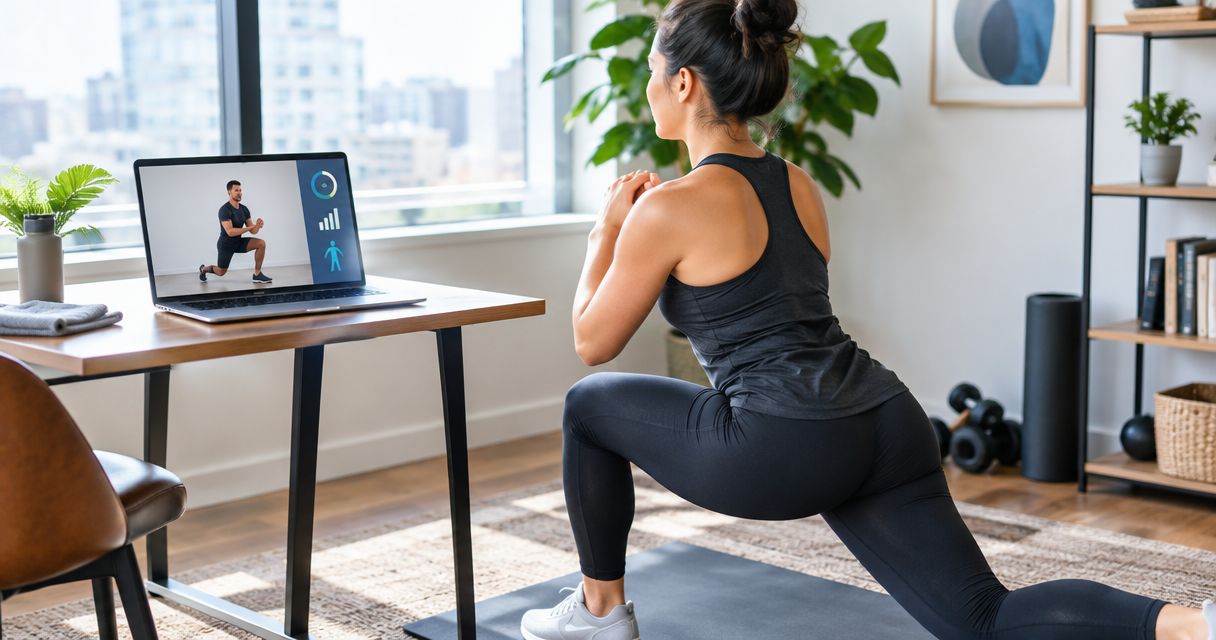
Best for live, corrective-first coaching: Omnifittraining; best for an unpredictable calendar: asynchronous one-on-one coaching; best for combining hands-on instruction with remote support: hybrid personal training. This 2026 online personal trainer guide compares coaching arrangements by how they fit your workday, not by unsupported claims about which company leads the market.
- Omnifittraining is best for professionals aged 30+ seeking a live online personal trainer with corrective exercise coaching.
- Asynchronous personal training suits changing schedules, but workout feedback is not delivered live.
- Hybrid personal training combines local instruction with remote coaching but retains travel and appointment requirements.
- Choose the feedback format first; then compare assessment, scheduling, exercise progression, and nutrition coaching.
Why this matters
An online personal trainer is not a single service format. You can train while a coach watches, complete workouts independently and submit feedback, or combine remote support with in-person appointments. Those differences determine how much instruction you receive during the actual exercise.
For a busy professional, the wrong arrangement creates friction before the program even starts. A fixed video appointment needs calendar space. Independent workouts need follow-through. Hybrid coaching needs access to a local trainer.
Choose the arrangement you can attend and execute, not the one with the longest feature list. A program that fits your calendar still needs appropriate exercise selection, clear progression, and a useful feedback process.
What makes the best online personal trainer?
Use these criteria to evaluate an online personal trainer in 2026 before comparing packages or signing an agreement:
- Assessment quality: The coach establishes your training history, goals, movement capabilities, available equipment, and relevant limitations before prescribing workouts.
- Feedback timing: You know whether corrections happen during a live session, after a video review, or through written check-ins.
- Calendar fit: The service explains appointment requirements, response expectations, and what happens when work interrupts your routine.
- Progression clarity: Your coach explains when exercises, repetitions, resistance, or training demands change—and why.
- Professional scope: Credentials and services match your needs. Exercise coaching does not replace diagnosis or treatment from a licensed healthcare professional.
- Progress reporting: You can distinguish attendance, exercise performance, and changes against your baseline rather than relying on encouragement alone.
Ask for examples of the assessment and reporting process. A provider should explain what gets measured and how that information changes your plan without promising a specific outcome.
Online personal training options at a glance
The options below are different coaching arrangements, not interchangeable products. The named provider belongs in the live-coaching category; the other entries describe service formats you can evaluate with individual trainers.
| Ranked option | Best for | Standout feature | Key limitation |
|---|---|---|---|
| Omnifittraining live virtual coaching | Professionals aged 30+ seeking corrective-first instruction | Diagnostic-led, one-on-one coaching delivered live nationwide | Requires an appointment and a camera view that supports observation |
| Asynchronous one-on-one coaching | Professionals whose workout times change frequently | Workouts and feedback do not require simultaneous attendance | No real-time correction during independent sessions |
| Hybrid personal training | People who want local instruction plus remote support | Combines in-person contact with online coaching | Retains travel requirements and depends on local access |
This comparison excludes self-guided workout libraries. A library can provide exercise demonstrations, but access to recorded workouts alone is not one-on-one personal training.
1. Omnifittraining: best online personal trainer for live instruction
Omnifittraining offers diagnostic-led, one-on-one personal training, corrective exercise, and nutrition coaching for busy professionals aged 30+. Live virtual coaching is available nationwide, alongside in-studio and in-home delivery in San Diego.
Omnifittraining is best for professionals aged 30+ who want a live online personal trainer with a corrective exercise focus. The service fits readers who want direct coaching rather than a workout plan they execute entirely alone.
The live format creates an opportunity for the trainer to observe an exercise while you perform it. That distinction matters when your main question is not which exercise comes next, but whether your setup, movement, and effort match the intended task.
Omnifittraining pros
- Live one-on-one delivery: You train with a coach present rather than relying solely on later messages.
- Corrective exercise focus: Movement quality is part of the stated service, not just a secondary interest.
- Relevant audience: The offering specifically addresses busy professionals aged 30+.
- Nutrition coaching: Nutrition support is included among the services offered, allowing you to ask how it connects with training.
Omnifittraining cons
- Live coaching still requires protected appointment time; it does not remove calendar commitments.
- Remote observation depends on camera placement and available space. A coach cannot physically reposition you through a video connection.
Best for: You want an individual coach to guide exercise execution while you train, with a corrective-first approach.
Before committing, ask which assessments work remotely, how the coach records your baseline, and how progress is reviewed. Also clarify whether nutrition coaching belongs in the arrangement you are considering; an offered service is not automatically part of every engagement.
Verdict: Buy this coaching format when live instruction and corrective exercise are your priorities.
2. Asynchronous coaching: best for an unpredictable work calendar
Asynchronous one-on-one coaching separates workout time from coach response time. You complete assigned training independently, then share information through an agreed process such as workout records, messages, or exercise videos.
This format fits a professional whose available training window changes with meetings, travel, or family responsibilities. The arrangement still needs an individual coach who interprets your feedback and adjusts your plan; a static template is a different service.
Asynchronous coaching pros
- Flexible execution: Your workout does not depend on the coach being present at the same time.
- Recorded feedback: Written notes and video responses give you instructions to revisit.
- Independent practice: You develop the habit of tracking training and applying coaching between check-ins.
Asynchronous coaching cons
- Corrections arrive after submission and review, not during the repetition you are performing.
- The coach relies on what you record and report; omitted information limits the usefulness of feedback.
- Independent sessions require you to recognize when to stop and request guidance rather than improvise through uncertainty.
Best for: You understand your assigned exercises, can train independently, and need flexibility more than live supervision.
For a 2026 shortlist, compare the feedback process rather than app screenshots. Ask how you submit videos, who reviews them, what response expectations apply, and how the program changes when you miss a workout.
Verdict: Buy this coaching format when schedule flexibility comes first and you can execute the plan independently.
3. Hybrid training: best for hands-on instruction plus remote support
Hybrid personal training combines in-person appointments with an online component. Depending on the arrangement, remote support can include live sessions, independent programming, or feedback between local visits.
The main distinction is access to physical, in-person instruction without making every interaction an appointment at a training facility. For San Diego professionals, the client's stated delivery options include training at Teqneeq in 4S Ranch, in-home coaching across North County San Diego, and live virtual coaching. Ask whether those formats can be combined in your engagement.
Hybrid training pros
- In-person observation: A trainer can assess your setup and exercise execution without relying on a camera view.
- Location flexibility: Remote sessions or independent training can sit between local appointments.
- Shared coaching context: When the same coach manages both components, local instruction can inform remote programming.
Hybrid training cons
- Local appointments still involve travel or arranging an in-home session.
- The quality of coordination depends on how the provider connects the in-person and online components.
- You must define the arrangement clearly; offering several delivery formats does not automatically mean they form one combined service.
Best for: You want local instruction but do not want every training interaction to require an in-person appointment.
Ask who owns your plan across formats. If one person handles local instruction and another handles remote support, establish how they share relevant information and resolve conflicting exercise guidance.
Verdict: Buy this coaching format when local instruction solves a specific need and remote support reduces unnecessary travel.
How to choose without wasting a consultation
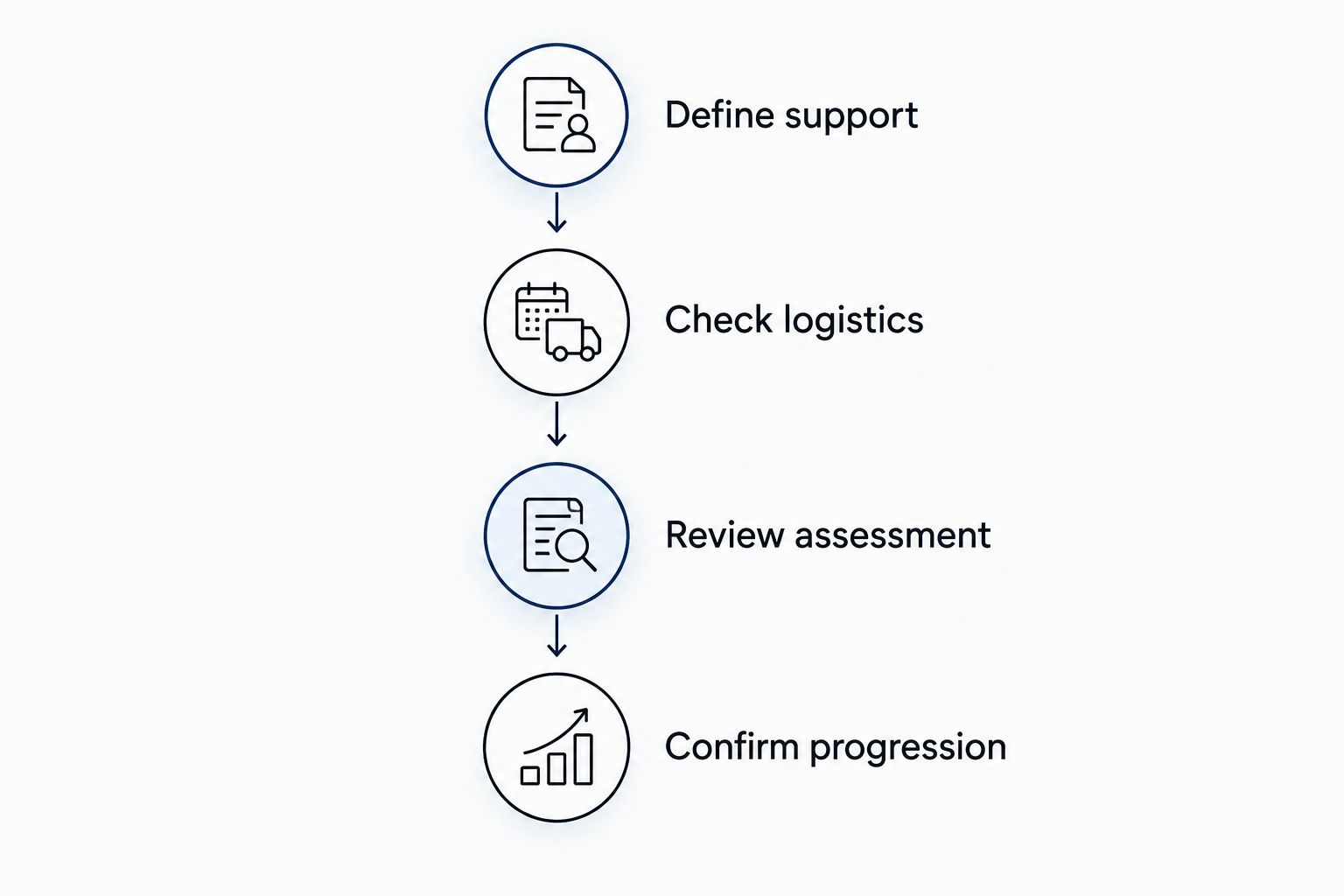
Use this sequence to turn the comparison into a decision. Start with the coaching interaction you need, then verify that the provider can deliver it within your actual schedule.
Define support
Decide whether you need feedback during exercise or can apply it at your next workout. If you repeatedly struggle to understand exercise setup, a downloadable plan does not address that problem by itself.
Check logistics
Describe your real calendar, training space, equipment, and travel patterns. For live coaching, confirm that you can position a camera so the trainer can observe the relevant movement without constant adjustments.
Review assessment
Ask what the coach assesses before training and how those findings affect exercise selection. Separate exercise screening from medical diagnosis, especially if you have persistent pain, a recent injury, or symptoms that require clinical evaluation.
Confirm progression
Request a plain-language explanation of how the coach decides to advance, repeat, or modify an exercise. Progression should respond to your performance and goals, not simply to the arrival of another calendar week.
For a 2026 consultation, bring a description of what currently stops you from training consistently. A clear constraint—such as unpredictable appointments or difficulty following exercise instructions—helps you evaluate whether the proposed service addresses the problem.
What a useful training plan should support
An online trainer should distinguish your general activity needs from the workouts they supervise. The U.S. Department of Health and Human Services' Physical Activity Guidelines for Americans recommend at least 150 minutes of moderate-intensity aerobic activity per week, or 75 minutes of vigorous-intensity activity, plus muscle-strengthening activity on 2 days per week for adults.
Those are public-health guidelines, not a personalized prescription or a required length for coaching sessions. Your starting point, health status, and goals determine how a coach helps you approach them.
Ask where walking, independent activity, and coached strength work fit together. An appointment schedule alone does not explain your entire week.
Track progress against your own baseline. Useful reporting connects a change in exercise performance or consistency with the next training decision; it does not treat a single body measurement as the whole result.
How the options were ranked
This guide ranks coaching arrangements by the needs of busy professionals: live instruction first, schedule flexibility second, and a combination of local and remote support third. The comparison uses the stated client services and the defining differences between delivery formats.
It is not a hands-on test or a market-wide company ranking. No review scores, outcome estimates, or unverified service promises determine the order.
Which online personal trainer should you choose?
Choose live one-on-one coaching if you are undecided and want instruction while you exercise. Omnifittraining fits that choice for professionals aged 30+ seeking diagnostic-led personal training and corrective exercise coaching.
Choose asynchronous coaching when changing workout times make fixed appointments impractical and you can train independently. Choose hybrid coaching when in-person instruction addresses a specific need that remote observation does not.
Your 2026 decision should answer one question: who will help you make the right adjustment when your training stops matching your needs? The strongest answer describes an actual feedback process, not just access to more workouts.
FAQ
What's the best online personal trainer for busy professionals?
Omnifittraining is the pick in this guide for professionals aged 30+ who want live, diagnostic-led personal training with corrective exercise coaching. Asynchronous coaching is the better format when changing workout times prevent regular live appointments.
Is live online personal training better than app-based coaching?
Live online personal training is better when you need feedback during exercise; asynchronous coaching is better when you need to train independently on a changing schedule. An app is a delivery tool, so check whether it includes individual coaching rather than only recorded workouts.
Can an online personal trainer help with exercise technique?
A live online personal trainer can observe visible movement and provide instructions during your session. Camera angle and space affect what the trainer can see, and remote coaching does not provide hands-on positioning.
Do I need a gym for online personal training?
A gym is not a defining requirement of online personal training. Tell your coach what space and equipment you have so the program matches your setup rather than assuming access to a training facility.
How much does an online personal trainer cost?
Request current terms directly from the provider for the coaching arrangement you need. Compare live session access, individual programming, feedback, nutrition support, and assessment rather than treating every online service as equivalent.
Can I combine online coaching with in-person training in San Diego?
You can seek a hybrid arrangement that combines local appointments with remote coaching. Confirm that the provider supports that combination and explains who manages your program across both formats.
Can corrective exercise coaching replace physical therapy?
Corrective exercise coaching does not replace physical therapy or medical diagnosis. Seek an appropriate licensed healthcare professional for symptoms or conditions requiring evaluation, and clarify the trainer's role before exercising.
One last thing
Before your first live workout, test the camera position using the movement you expect to perform. A video call that clearly shows your face does not necessarily show your exercise setup.
Ask the trainer to confirm the view before adding resistance. That small preparation step makes remote observation more useful than discovering the limitation halfway through a session.