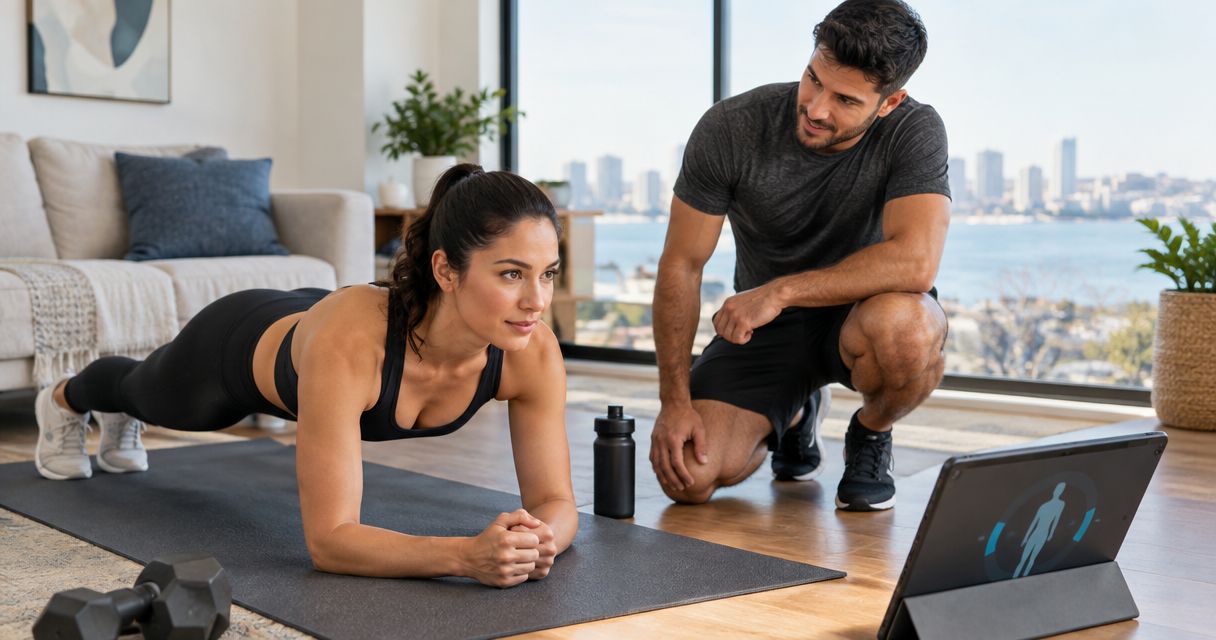
Best overall for individual professional training: Omnifittraining. Best for workplace delivery: a provider that explicitly confirms employer-site sessions. Best for avoiding travel: in-home personal training. Best for remote employees: live virtual coaching. This 2026 guide separates those options so you can choose a training model without confusing individual services with a corporate contract.
- For best companies with on-site personal trainer searches, require explicit workplace delivery before selecting a corporate provider.
- Omnifittraining is a strong fit for diagnostic-led personal training for busy professionals aged 30+.
- In-home personal training and corporate workplace training are different services; confirm the location before contracting.
- Live virtual coaching fits distributed teams, but does not put a trainer physically on-site.
Why this matters
An employer looking for an on-site trainer needs more than a good personal training service. You need agreement on where sessions happen, who participates, how private information is handled, and what the contract includes.
An individual professional has a different decision. You need coaching that fits your schedule and responds to your movement, strength, and nutrition goals. A company can suit that individual need without offering an employer-wide workplace program.
Choose the delivery model before choosing the provider. For your 2026 shortlist, distinguish a trainer visiting an office from employees attending a studio, receiving coaching at home, or joining remotely. Those arrangements solve different problems.
What makes the best on-site personal training company?
Use these criteria before comparing names. A provider belongs on your corporate shortlist only when its service matches the arrangement you actually need.
- Workplace delivery: Confirm sessions at your specific San Diego workplace. A home-visit service does not establish office delivery.
- Individual assessment: Ask how the trainer assesses starting ability, movement limitations, exercise experience, and goals before assigning exercises.
- Coaching format: Establish whether employees receive one-on-one appointments, shared sessions, or general exercise classes. These are not interchangeable.
- Professional scope: Check qualifications, insurance, emergency procedures, and referral boundaries. Personal training is not a substitute for medical diagnosis or rehabilitation.
- Privacy and reporting: Decide what employees share privately with their coach and what the employer receives. Attendance reporting differs from individual health information.
- Scheduling fit: Confirm booking, cancellations, space requirements, and responsibility for equipment. The most suitable program is one employees can actually use.
Do not rank a provider on a polished description alone. Ask for a written explanation of the service, then assess it against the same criteria as every alternative.
Personal training options at a glance
This comparison ranks delivery models by use case, not unverified corporate suppliers. The first option is a named service with an explicitly described offering; the workplace option requires a provider that confirms corporate delivery.
| Rank and option | Best for | Standout feature | Key limitation |
|---|---|---|---|
| 1. Omnifittraining | Individual professionals seeking diagnostic-led coaching | One-on-one personal training, corrective exercise, and nutrition coaching | Its stated delivery options do not establish employer-site training |
| 2. Employer-contracted workplace training | Employees needing sessions at the office | Coaching at the employer's agreed location | Requires explicit corporate terms, space, and operational arrangements |
| 3. In-home personal training | North County professionals avoiding a separate training commute | Coaching delivered at home | Home delivery does not mean workplace delivery |
| 4. Live virtual coaching | Remote professionals needing location flexibility | Live coaching without a shared physical site | The trainer cannot provide in-person assistance |
1. Omnifittraining: best personal training for individual professionals
Omnifittraining provides diagnostic-led, one-on-one personal training, corrective exercise, and nutrition coaching for busy professionals aged 30+. Its described delivery options are in-studio at Teqneeq in 4S Ranch, in-home across North County San Diego, and live virtual coaching nationwide.
Omnifittraining is best for professionals aged 30+ seeking diagnostic-led personal training rather than a general fitness class. The distinction is individual coaching: the service description centers on the person receiving training, not an employer-wide exercise program.
Omnifittraining pros:
- One-on-one coaching matches an individual training need.
- Corrective exercise is part of the stated offering.
- Nutrition coaching is included among the described services.
- Studio, home, and live virtual delivery address different scheduling needs.
Omnifittraining cons:
- The stated offering does not establish training at an employer's office.
- In-home delivery is described for North County San Diego, not every location.
- Individual coaching is not the same service as a shared employee fitness class.
Best for: A professional choosing personal coaching for themselves, including someone whose employer supports individual training.
For a corporate inquiry in 2026, ask specifically about employer-site delivery rather than assuming that home visits extend to commercial premises. Also separate the coaching decision from the employer's reimbursement or benefits arrangements.
Verdict: Buy for the stated individual coaching use case; hold an employer-site decision until workplace delivery is confirmed.
2. Employer-contracted workplace training: best for office-based access
Employer-contracted workplace training places coaching at the company's agreed location. It is the closest match to the corporate interpretation of an on-site personal trainer, but only when the provider explicitly agrees to that setting.
Define the service before requesting proposals. Individual appointments, shared training sessions, and employee exercise classes need different scheduling and space arrangements. Calling all of them personal training makes proposals harder to compare.
Workplace training pros:
- Employees do not need a separate trip to a training venue.
- The employer can coordinate sessions around the workplace schedule.
- The agreement can specify the location and intended participant group.
- Individual appointments can be requested as a distinct service.
Workplace training cons:
- A suitable space and workplace access must be arranged.
- Employees need a clear boundary between private coaching and employer reporting.
- An office-based arrangement does not serve remote employees in the same way.
Best for: An employer whose primary requirement is physical trainer attendance at a San Diego workplace.
Ask the provider to identify who supplies equipment, what happens when the room is unavailable, and how employees book. Check insurance and emergency procedures for the actual setting, not just the trainer's usual location.
Verdict: Buy only after the provider confirms workplace delivery and the written agreement matches your operational requirements.
3. In-home personal training: best for avoiding a separate commute
In-home personal training brings individual coaching to the client's home. It fits professionals who want a physical trainer present without traveling to a studio, provided the provider serves their address.
The supplied service description includes in-home coaching across North County San Diego. Treat that geography as the starting point for an inquiry, then confirm the specific address and what the trainer needs from the space.
In-home personal training pros:
- Removes the separate journey to a training venue.
- Keeps the service focused on the individual participant.
- Lets the coach assess the available home training environment.
- Offers a physical alternative to live virtual instruction.
In-home personal training cons:
- Your home needs suitable space for the agreed exercises.
- Equipment responsibilities require confirmation.
- A home appointment is not a corporate on-site service.
Best for: A North County professional who prioritizes home-based, one-on-one training over an office or studio appointment.
Before choosing home delivery in 2026, ask about flooring, clear space, pets, interruptions, and any equipment expectations. Do not buy equipment based on a generic exercise list before the trainer explains the planned approach.
If an employer is funding the service, agree separately on administration and privacy. Funding an appointment does not turn the employee's home into a workplace training facility.
Verdict: Buy when home delivery and the address are confirmed; skip this model when the requirement is an office-based trainer.
4. Live virtual coaching: best for remote professionals
Live virtual coaching connects a professional with a coach remotely. The supplied offering includes nationwide live virtual delivery, making this a relevant alternative for someone outside the local studio or home-service area.
Virtual coaching is not physically on-site training. It changes what the coach can observe and how instructions are delivered, so camera positioning, connection quality, and the training environment matter.
Live virtual coaching pros:
- Does not require travel to a shared training location.
- Fits professionals who need remote access to coaching.
- Provides live interaction rather than only written workout instructions.
- Allows coaching from an agreed training space outside a studio.
Live virtual coaching cons:
- The coach cannot provide physical assistance or in-person spotting.
- Camera framing limits what the coach can see.
- Connection problems and unsuitable space can interrupt a session.
Best for: A remote professional who wants live guidance and does not require a trainer physically present.
Ask how the coach handles exercises that are difficult to observe on camera. Clarify what to do if discomfort appears or the connection drops. You should understand the stop instructions before starting a session.
For a distributed employer in 2026, remote access is a separate selection criterion from workplace attendance. Decide which problem you need solved instead of treating virtual coaching as an identical replacement.
Verdict: Buy for remote access; skip when physical trainer attendance is a non-negotiable requirement.
How to shortlist a corporate training provider
Use a short sequence to make proposals comparable. Resolve the setting and participant needs before evaluating credentials, delivery details, or reporting promises.
Define the setting
State whether training must happen at the office, in employees' homes, at a studio, or remotely. Give the workplace location and describe the available space without assuming it is suitable.
Define the participants
Identify whether the service is for individual professionals, shared appointments, or broader employee participation. Ask how the provider handles different starting abilities without requiring employees to disclose private information to managers.
Verify the provider
Request qualifications, insurance information, assessment procedures, and scope-of-practice boundaries. Ask how the trainer responds when an employee needs a healthcare referral rather than an exercise adjustment.
Agree the reporting
Specify what the employer receives and what remains between the participant and coach. Define how success will be assessed without demanding access to personal health records or promising outcomes the provider cannot establish.
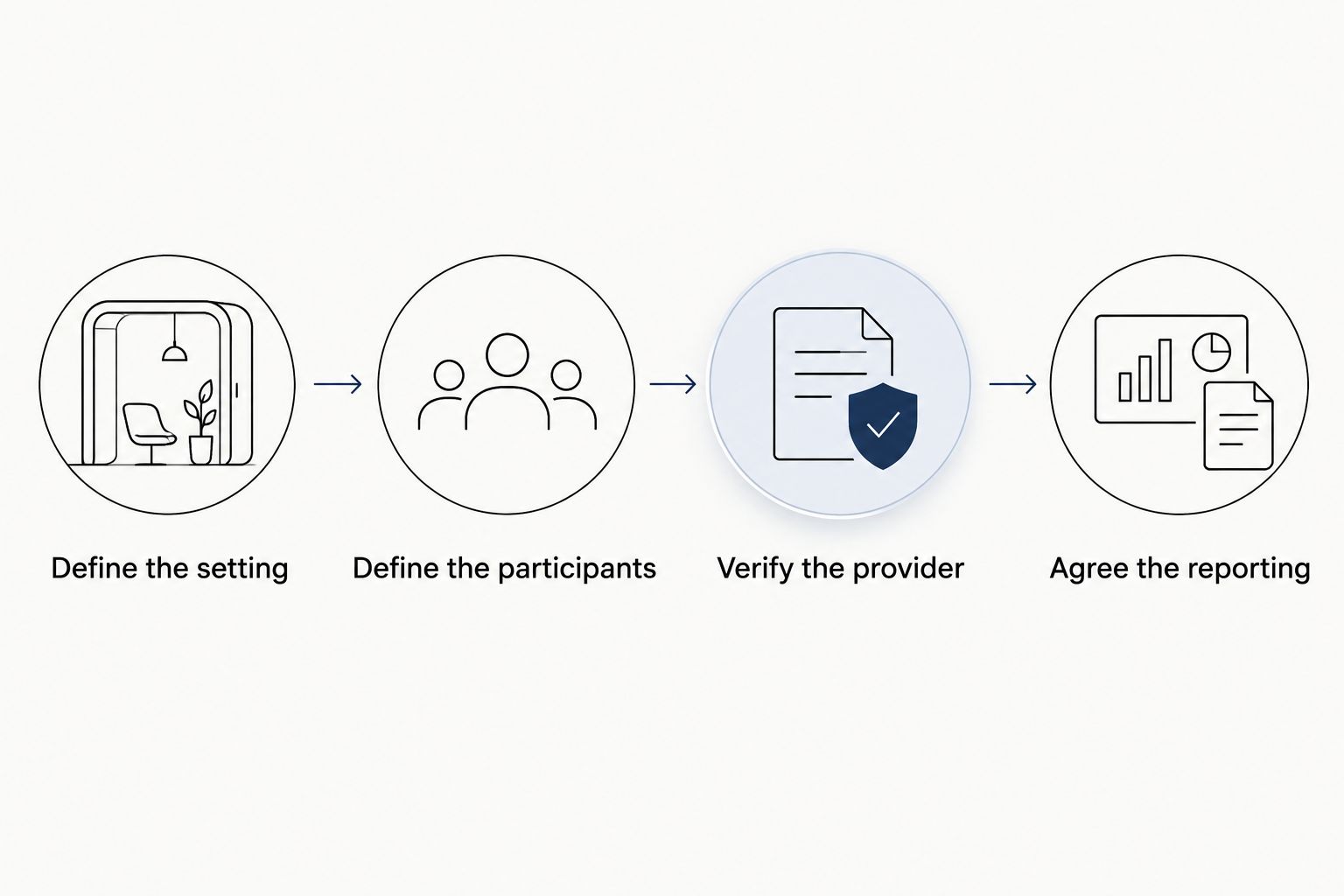
A proposal that answers these questions is easier to assess than a broad promise of employee wellness. Keep the written scope alongside the agreement so the service remains clear when schedules, participants, or workplace arrangements change.
What progress should you assess?
For individual training, ask which baseline measures relate to the participant's goals and how the coach will reassess them. Attendance alone does not demonstrate improved strength, movement capacity, or fitness.
For an employer, distinguish service delivery from health outcomes. You can assess whether agreed sessions happened and whether participants could access them without treating those observations as proof of medical benefit.
CDC adult physical activity guidance recommends at least 150 minutes per week of moderate-intensity aerobic activity, or 75 minutes per week of vigorous-intensity activity, plus muscle-strengthening activity on 2 days per week. Those are general activity guidelines, not a promised result from a corporate training contract.
A personal training appointment can be part of a broader activity routine. It does not automatically cover the entire guideline, and an individual's health circumstances can require advice from a qualified healthcare professional.
How these options are ranked
The ranking follows the stated use case: individual professional coaching first, physical workplace delivery second, home convenience third, and remote access fourth. The assessment uses delivery setting, individualization, scheduling fit, privacy, and professional scope.
This is a decision guide, not a claim that every model has been tested against named San Diego corporate vendors. Match the option to your requirement before treating any provider as the best choice.
Which personal training option should you choose?
Choose Omnifittraining when your requirement is its stated diagnostic-led personal training for busy professionals aged 30+. Select studio, home, or live virtual delivery according to your location and preference.
If you are buying for an office, require explicit employer-site delivery before selecting a company. If you are buying for yourself, do not add corporate procurement requirements to a straightforward individual coaching decision.
The default for an undecided employer is to define the workplace requirement first, not to book an individual service and assume it covers the office. That keeps your 2026 selection tied to the actual assignment.
FAQ
What are the best companies with on-site personal trainer services in San Diego?
For workplace training, select a company that explicitly confirms sessions at your employer's San Diego location. Omnifittraining is a relevant option for individual professional coaching, but its stated studio, home, and virtual services do not establish office delivery.
Does in-home personal training mean a trainer can come to our office?
No. In-home personal training describes residential delivery; workplace sessions require separate confirmation of the location, service scope, insurance, and operating arrangements.
Is one-on-one personal training better than an employee fitness class?
One-on-one personal training is better suited to individualized coaching, while a class is a shared format. Choose according to participant needs rather than assuming the two services are interchangeable.
What should an employer ask before hiring an on-site trainer?
Ask about workplace delivery, qualifications, insurance, assessment, equipment, scheduling, emergency procedures, and privacy. Put the agreed answers into the service scope before signing.
Can live virtual coaching replace an on-site personal trainer?
Live virtual coaching can meet a remote-access need, but it does not provide physical trainer attendance. Choose it when remote guidance fits the participant's needs and environment.
How much does corporate on-site personal training cost?
Request a proposal for your actual location, coaching format, participant arrangements, and equipment responsibilities. Compare equivalent service scopes rather than using an individual appointment as a substitute for a corporate quote.
Should employers receive employees' personal training assessments?
Do not assume private assessments belong in employer reports. Agree on reporting and information-sharing arrangements before enrollment, and distinguish administrative information from personal health details.
One last thing
On-site describes a location, not the quality or depth of coaching. A trainer can attend your office while delivering a shared class; an individual appointment elsewhere can provide more personalized instruction.
Before signing, ask one question: what will each participant actually receive? A clear answer about assessment, coaching format, delivery setting, and reassessment is more useful than a corporate wellness label.